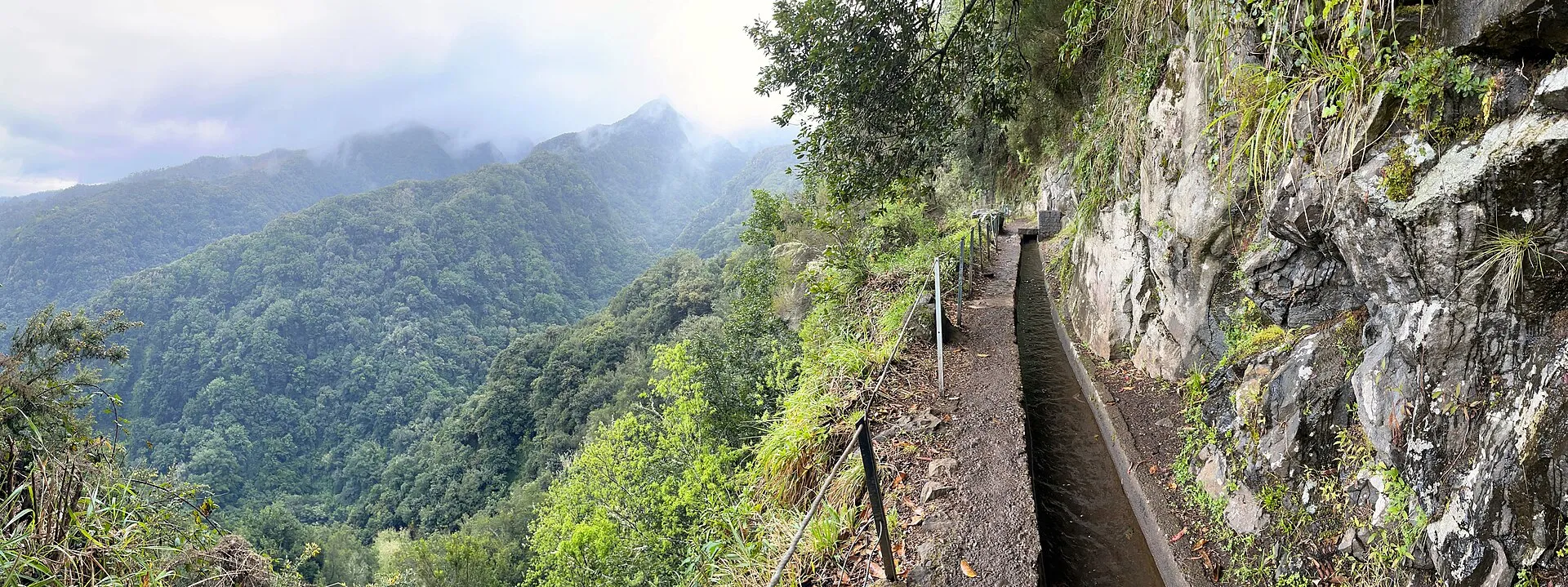
Madeira’s levadas are water channels. The first ones were dug in the 1400s, soon after the island was settled, to carry water from the rainy north and the high interior to the sunnier, drier south, where people wanted to farm. Over five centuries they grew into a network of more than two thousand kilometres, and the narrow path the builders left beside the water is the path you walk today.
In short
- A levada is an irrigation channel on a gentle slope, with a maintenance path alongside.
- They exist because the rain falls on one side of the island and the good farmland is on the other.
- Sugar paid for the first ones. Bananas, drinking water and hydroelectric power paid for the biggest.
- Water was shared by strict turns, run by a keeper called the levadeiro.
- Most are still working. Walking them is a later use, not the original one.
The problem the levadas solved
Stand on the ridge at Pico do Areeiro on a windy day and you can watch the island’s water problem happen. Moist Atlantic air hits the north side, rises, cools and drops its rain on the mountains and the north coast. The south, in the shadow of the ridge, gets far less.
The south, though, is where the gentler slopes are, and the sun, and the sheltered bays where the first settlers landed in the 1420s. So from the start there was a mismatch: water in one place, land and people in another. You catch the water where it falls, at a spring, a stream or a high valley, and lead it along the contour of the mountain, dropping just enough to keep it moving, until it reaches the fields.
Sugar, and who did the digging
The first big reason to move water was sugar. In the late 1400s and early 1500s Madeira was one of Europe’s main sources of it, and cane is a thirsty crop, far thirstier than the wheat the settlers first planted. Channels were cut to the cane fields and to the mills that crushed it.
The work was done by hand, with picks and chisels, on some of the steepest ground in Europe. Where a channel had to cross a cliff, men worked hanging in wicker baskets on ropes to cut a ledge into the rock. An account from the 1500s describes exactly that, and the many men who died doing it. Much of that labour was not free. Enslaved Africans and Canary Islanders were among the early builders, alongside convicts sent from mainland Portugal. It is worth remembering when the path feels easy.
In the second half of the 1500s Madeira’s sugar went into crisis: the cane suffered disease, and the Canaries, São Tomé and above all Brazil were producing more. The Caribbean added to the pressure later. From the middle of the 1600s to the early 1800s, building slowed right down while wine took over as the island’s great export. Some channels from that quieter period are still walked: the one to Caldeirão Verde was built in the 1700s to water the fields of Faial.
The 1800s: through the mountain
The 19th century brought the next big push. Disease wrecked the vineyards, first oidium in 1852 and then phylloxera from 1872, and many farmers went back to cane, which needed water again. At the same time the streams of the south were no longer enough, and for the first time the state stepped in to build channels itself.
Rabaçal is where you can see it. In 1855 the Túnel das Estrebarias, the “old tunnel”, was cut through the ridge, and according to the tourism board it was the first time water from the north side of the island crossed to the dry south. Its entrance is a short detour off the Levada Velha do Rabaçal. A few years later work began on the Túnel do Cavalo, about 800 metres long, started in 1863 and finished only in 1877. It still carries the water of 25 Fontes towards Calheta, and you can walk through it with a headlamp and wet feet.
The 1900s: bananas and turbines
The largest channels came in the 20th century, when bananas replaced much of the cane and Funchal needed drinking water. From the 1940s a state body, the Comissão Administrativa dos Aproveitamentos Hidráulicos da Madeira, built long new levadas at a scale nothing before had reached, and tied them to hydroelectric stations. The Levada dos Tornos, around 106 km from the north side to the south coast, was finished in 1966. Its water turns turbines at Fajã da Nogueira, the power station you can see from the Balcões viewpoint, before it reaches the taps and banana terraces of the south.
You pass those terraces, cut by hand over five centuries, on the west coast drive.
Water by the clock: the levadeiro
A levada was never just a ditch. It was shared property, and a family’s harvest depended on getting its share.
The water was divided by time. Each landowner along a channel had the right to the flow for a fixed number of hours, and the round from one watering of a plot to the next is the giro. In summer, when rain is scarce, the levadas still run in giro, usually from May to September. When your turn came, you lifted the small gate to your plot; when it ended, you dropped it and the water went on down the line.
Keeping that rotation honest was the job of the levadeiro, the keeper of the channel. He walked his stretch, often in the dark before a turn began, lifting out leaves, stones and mud; he opened and shut the gates on time; he patched leaks before they became collapses; and he was the first person anyone came to when a neighbour was suspected of taking more than his hours. Working levadas still have keepers today.
How long is the network?
Estimates run from a little over 2,000 km to more than 3,000 km. The larger figure counts around 800 km of main channels and some 2,300 km of smaller branches. Tunnels add somewhere between 25 and 40 km more, depending on the source. Only a small part of all this is a waymarked walking trail.
From water path to walking path
The paths beside the channels were built for the keeper and the repair gangs, not for visitors. They are narrow because they only needed to take one person carrying tools. They are nearly flat because water needs a gentle fall. And they go to improbable places, along cliff faces and deep into valleys, because that is where the water was.
Walkers began following them in numbers in the 20th century, and the laurel forest many of them cross was listed by UNESCO as a World Heritage Site in December 1999. Today the best-known stretches are classified trails, waymarked and maintained, and since January 2026 booked in advance.
When you walk to 25 Fontes, or along the Levada do Rei above São Jorge, you are on infrastructure that still has a job to do. Keep out of the channel, throw nothing in, and if you meet someone clearing leaves with a long-handled tool, step aside. That is probably the levadeiro.
The Tropi Guide audio tour of the north coast stops at a sugar mill still running on steam, the other half of this story.
Questions people ask
What is a levada?
A levada is a narrow, gently sloping water channel that carries water across Madeira's mountains, usually from the wet north and the high interior to farmland in the drier south. The path beside it, built for maintenance, is what walkers use today.
Why were the levadas built?
To take water to where the farmland was. The first settlers in the 1400s needed it for crops, above all sugar cane. Later channels served bananas, drinking water and, from the 20th century, hydroelectric power.
Who built the levadas?
Labourers working by hand with picks and chisels over five centuries, among them enslaved people and convicts in the early years. The big 20th-century channels were built by a state commission.
What is a levadeiro?
The keeper of a levada. The levadeiro kept the channel clear, opened and closed the gates, and made sure each landowner got their share of water at the right time.
Are the levadas still used for water?
Yes. Most still carry water for farms, homes or power stations. You are walking on a working water system, which is why you should never block or dirty the channel.