Madeira is a volcanic island with a coast of cliffs, black boulders and lava shelves, and almost no natural sand. What it has instead is some of the clearest water in the Atlantic, lava pools that stay calm while the sea crashes next door, and swimming complexes built into the rock. Come for the swimming, not for the beach towel on golden sand, and you will not be disappointed.
In short
- Only two beaches on the main island have sand, Calheta and Machico, and it was shipped in.
- The best swims are in lava pools (Porto Moniz, Seixal, Porto da Cruz) and lidos built on the rocks (Funchal).
- Managed pools charge a few euros and have lifeguards. Wild pools and pebble beaches are free and have neither.
- The south coast is calmer and warmer. The north is wilder, colder and often too rough.
- For a proper sand beach, take the ferry to Porto Santo.
Paying for a swim, or not
Look for the words complexo balnear on a sign. It means concrete sunbathing terraces, a ladder or steps into the sea, sometimes a pool of filtered seawater, cold showers, a café and a lifeguard in a chair. In Funchal that costs €6; elsewhere it is often less. It is the closest thing Madeira has to a beach club, and on a rough day it is the only place you can get into the water safely.
The rest of the coast is yours for nothing, and nobody is looking after you. Boulders move under your feet, green weed on the rock is as slippery as ice, and getting out is harder than getting in. On a flat morning these are the loveliest swims on the island. When a swell is running, stay out, and be most careful of the rock pools right at the sea’s edge: a bigger wave every few minutes comes straight over the wall.
Madeira’s sandy beaches
Calheta
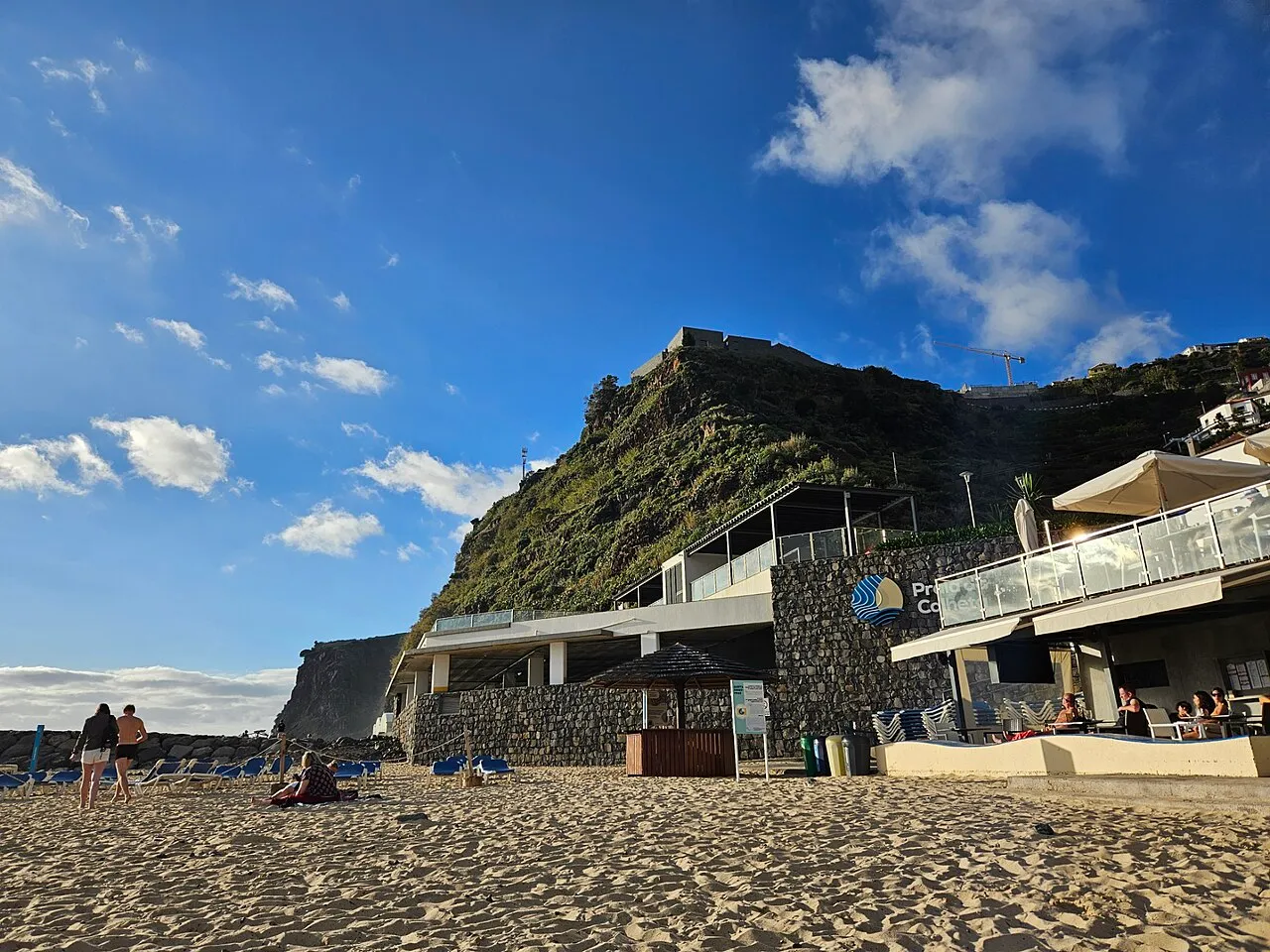
The obvious choice for small children. Calheta, on the south-west coast, has golden sand imported from Morocco when the marina was built, breakwaters that keep the water calm and shallow, lifeguards in season, beach bars and changing rooms. The sea here in August is in the low twenties, as warm as it gets on the island. The downside is that it looks like what it is, an artificial beach beside a marina and a hotel. It fills up on summer weekends when half of the west coast has the same idea. Calheta is also one of the sunniest parts of the island, so on a grey day in Funchal it is worth the drive.
Machico
The other sand beach is at Machico, the town in the east where the first settlers landed. The bay is sheltered by hills on both sides and the water is calm most days. It has a real town behind it, cafés within a few steps, and it is ten minutes from the airport. That last point cuts both ways: aircraft lining up for the runway or climbing away from it pass close to the bay.
The dark sand coves
A few small beaches have natural dark sand, formed from the island’s own rock. Prainha, near Caniçal at the eastern end, is a small cove under a cliff with no facilities at all and a short path down from the road. It faces south-east and gets the morning sun. On the north coast, the black sand beach at Seixal sits under green cliffs with a waterfall at one end, reached through a tunnel in the rock. It faces the open Atlantic, so the sea is often too big to swim. On a calm day in July it is one of the best places on the island.
Lava pools and sea pools
Porto Moniz
The famous ones, at the north-west tip. The sea fills basins in black lava, and you swim in still, clear water while waves break just beyond the rock. There are two sets. The managed pools have changing rooms, lifeguards, a bar and sunbeds, and cost €3 for anyone over three in 2026 (open 09:00 to 19:00 in summer, to 17:00 in winter). A few minutes west, below the Cachalote restaurant, the older natural pools cost nothing, are smaller, and have no facilities. The water is open Atlantic and feels bracing even in August.
Porto Moniz is on nearly every day-trip itinerary on the island, so by late morning it is crowded. Get there before 10:00 or after 16:00. See our Porto Moniz pools page, or drive there with our North-West road tour, which ends with the swim.
Seixal
East of Porto Moniz, Seixal has its own natural pools, the Poças das Lesmas, basalt basins at sea level with cliffs behind. They used to be a free, locals-only kind of place. Since 2024 there has been a lifeguard, toilets, showers and a small bar, and entry costs €2.50. Depths range from ankle-deep to over two metres, and in a northerly swell the waves still wash straight in, lifeguard or not. The black sand beach is a few minutes’ walk away, so you can see both in one stop.
Porto da Cruz
On the north-east coast, Porto da Cruz has a pebble beach you would not swim from on most days, and a free saltwater pool built into the rocks next to it that you would. Behind it the huge rock of Penha d’Águia rises straight out of the sea, and the rum distillery sits next door.
Funchal: lidos and a long pebble beach
The Lido
The easiest swim from the hotel zone. The Lido is a seafront complex with a large seawater pool, a children’s pool, ladders straight into the Atlantic, sunbeds, a restaurant, changing rooms and lifeguards. Entry was €6 for adults, €2 for ages 7 to 17 and free for under-sevens in September 2026. It is a pool day more than a sea day, and it is busy with families at weekends.
Doca do Cavacas
West of the hotel zone, where the promenade reaches Praia Formosa, Doca do Cavacas is a set of ladders and ledges in dark volcanic rock, with a proper swim straight into deep water. Same operator as the Lido, same €6. You will hear more Portuguese here. The restaurant of the same name sits on the rocks above (closed on Mondays) and is the place to stay on for a fish lunch.
Praia Formosa
A long curve of grey pebbles and black boulders west of the Lido, the biggest stretch of beach on this side of the island. A flat promenade runs behind it, with cafés, and it is free. There are changing rooms and a first-aid post, and since January 2026 lifeguards watch it all year, not just in summer. The stones are big, so walking into the sea is awkward and water shoes make a real difference. It is a good place for an evening swim after the heat has gone, with Cabo Girão standing up at the end of the view.
Barreirinha and the old town
Just east of the yellow fort, below the Socorro church, Barreirinha is a small bathing complex on a pebble cove, with a Blue Flag and a lifeguard (€6, like the Lido). It is a pleasant way to end a walk through the Fisherman’s Quarter.
Garajau
The best snorkelling near Funchal. The beach below the Cristo Rei statue in Caniço is inside the Garajau Marine Reserve, where fishing has been banned since 1986, so there are far more fish than anywhere else on the south coast. Groupers, rays, moray eels and the odd turtle are regular sightings, and on a calm day you can see 15 m or more. A small cable car drops from the road to the beach (a few euros return; reported prices vary), or you can take the steep path down. There is a dive centre on the beach.
Pebble beaches on the south-west coast
Driving west from Ribeira Brava on the old coast road, you pass a string of small stony beaches that cost nothing and have almost nothing. Ponta do Sol is the easiest: its seafront has cafés a few steps above the stones, so a swim turns into lunch without moving the car. Just west of the town, the Anjos beach is a sunset spot, though the old road to it and its waterfall is often closed for rockfall. Madalena do Mar, further on, is a plain strip of pebbles in front of banana plantations, rarely busy.
The last one, Praia do Portinho at Jardim do Mar, is really a surf spot. Big winter waves break off the point, and the boulders by the harbour wall are only for swimming when the sea is completely flat. The village itself, all lanes and banana terraces, is the reason to go.
North coast beaches: look before you swim
The north gets the full Atlantic swell for most of the year. The beaches are wilder and more beautiful, and the swim is often not possible. Two rules: look at the sea for five minutes before you go in, and if the locals are not swimming, you should not either.
Besides Seixal, Porto Moniz and Porto da Cruz, there are a few stony river-mouth beaches along this coast, such as the Ribeira do Natal near São Jorge, at the bottom of a steep, narrow road. No facilities, no lifeguard, and on a calm August afternoon perhaps a dozen people.
Quick comparison
| Place | Type | Cost (Sept 2026) | Lifeguard | Best for |
|---|---|---|---|---|
| Calheta | Imported sand | Free | In season | Small children, calm water |
| Machico | Imported sand | Free | In season | Easy family day in the east |
| Porto Moniz (managed) | Lava pools | €3 | Yes | Calm pools on the wild coast |
| Porto Moniz (old pools) | Lava pools | Free | No | Quieter, more natural |
| Lido, Funchal | Lido | €6 | Yes | Staying in Funchal |
| Barreirinha, Funchal | Lido and pebble cove | €6 | Yes | End of an old town walk |
| Garajau | Pebble, reserve | Free (lift a few euros) | In season | Snorkelling |
| Praia Formosa | Pebble | Free | All year (2026) | Evening swim, walk |
| Seixal pools | Lava pools | €2.50 | Yes | Calm days on the north coast |
| Seixal beach | Black sand | Free | No | Scenery |
Practical things
- Water shoes. Nearly every beach is stones or rock. They cost a few euros in any Funchal supermarket and they turn the entry from painful to easy.
- Water temperature. High teens in winter and the low twenties at the end of summer on the south coast: the Funchal harbour station averaged 23.4 °C in August 2025, 0.8 °C above normal. The north coast gets far more swell, so it often feels colder.
- Red flags mean it. When the flag is up at a managed complex, the sea access is closed. On wild beaches there is no flag, so use your own judgement.
- Sun. The breeze hides how strong it is. People burn on grey-looking days.
- Weather. A cloudy morning in Funchal can be clear in Calheta and Ponta do Sol. See our weather and packing guide and, for rough-sea safety, staying safe.
If you really want sand: Porto Santo
Porto Santo, the small island to the north-east, has what Madeira lacks: about 9 km of real golden sand along its south coast, shelving so slowly that you can walk out a long way. The ferry takes about two and a half hours each way, which makes a day trip mostly a boat trip. Book a night or two there instead.
Our app shows every beach and pool on the map with your position, so you can find the path down even without signal.
Questions people ask
Does Madeira have sandy beaches?
Two on the main island, at Calheta and Machico, and both use imported golden sand. There are a few small coves of natural dark sand, like Prainha and Seixal. For a long natural sand beach you need Porto Santo.
Where is the best place to swim in Madeira?
For calm water with facilities, the lava pools at Porto Moniz or the Lido in Funchal. For families with small children, Calheta. For snorkelling, Garajau, inside the marine reserve.
Are Madeira's natural pools free?
Some are, some are not. The managed pools at Porto Moniz (€3), the Seixal pools (€2.50) and the Funchal lidos (€6) charge and have lifeguards. The older pools beside Porto Moniz and many smaller ones are free, with no facilities or lifeguard.
Do I need water shoes in Madeira?
They help. Most beaches are pebbles or rock, and the lava pools can be slippery and sharp. Cheap ones from a supermarket in Funchal are fine.
When is the sea warm enough to swim in Madeira?
Most people swim from June to October, when the sea off Funchal is in the low twenties (it averaged 23.4 °C in August 2025). The north coast is rougher all year.