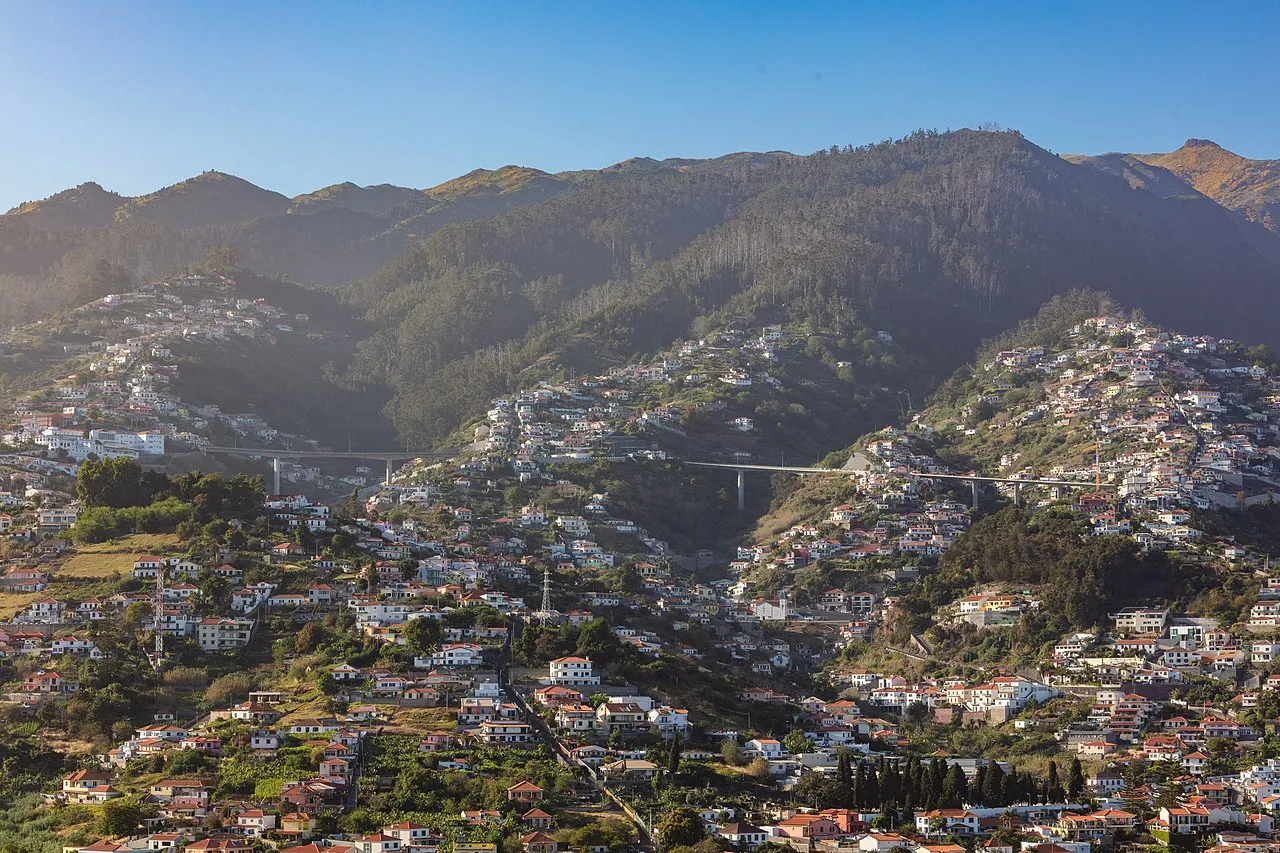
Funchal’s old town, the Zona Velha, is the few streets east of the city centre where the city began: a fishermen’s quarter squeezed between the market and a yellow sea fort. Its main street, Rua de Santa Maria, is narrow, cobbled and lined with doors painted by local artists, and it turns into one long dining room after dark. You can walk it end to end in twenty minutes, but give it a morning to look and an evening to eat.
In short
- The old town runs from the Mercado dos Lavradores east to the Fort of São Tiago, with Rua de Santa Maria as its spine.
- Go in the morning for the market and the painted doors, in the evening for dinner. They feel like two different places.
- The cable car to Monte leaves from the old town seafront.
- Restaurants on the main street are pricier and some staff will try to pull you in. Walk the length before choosing.
- It is all on foot. Do not try to drive in.
A short history, so the streets make sense
Funchal grew from the sea. The first settlers arrived in the 1420s, and the fishermen, boat builders and sailors lived at the east end of the bay, around the chapel of the Corpo Santo, while the merchants and the church built the grander city to the west. In October 1566 French corsairs landed at Praia Formosa, held the town for about two weeks, plundered it and killed more than two hundred people. The yellow fort at the end of the seafront was built afterwards, which is why our walking tour calls it the fort that came forty-eight years too late.
For most of the 20th century the old quarter was poor and half forgotten. Around 2010 and 2011 a project called arte de portas abertas (art of open doors) began inviting artists to paint the doors of the houses, and the street came back to life with bars and restaurants.
The walk: market to fort
This is a loop of about 2 km. Start at the market in the morning and you will have the doors mostly to yourself.
Mercado dos Lavradores
The farmers’ market, opened in November 1940, is a building of courtyards and galleries with tile panels of market scenes at the entrance. Fruit and flowers are on the ground floor and upper galleries; the fish hall is at the back, where the long black scabbard fish, eel-like and with huge eyes, is laid out on marble slabs in the morning. It opens early every weekday, stays open until 20:00 on Friday, closes at 14:00 on Saturday and does not open on Sunday.
Be careful at the fruit stalls near the entrance. Sellers offer tastes and then weigh up a bag at far more than the fruit is worth. Ask the price per kilo first, and do not be embarrassed to say no. Our Fisherman’s Quarter walking tour starts here and follows the story of the sea through the old town.
Largo do Corpo Santo and the fishermen’s chapel
Cross the road east of the market into the old quarter. The small square of the Corpo Santo has the whitewashed chapel the fishermen built in the 15th century for their patron saint, São Pedro Gonçalves Telmo. It has been rebuilt many times, but the pointed stone doorway is one of the oldest pieces of Funchal still standing. The houses around it are low and close together, as they were when this was the working end of the city.
Rua de Santa Maria and the painted doors
The oldest street in Funchal, and the reason people come. It runs for about 700 m, parallel to the sea, and nearly every door along it is painted: portraits, fish, flowers, abstract patterns, jokes. Some are by known Madeiran artists; some have been repainted several times. There are more in the side streets, so wander off the main line.
By day the street is quiet enough to look properly. From about 18:00 the restaurant tables come out, the menus appear, and the street becomes a corridor of dinner. Both are worth seeing. Our Doors of Funchal walking tour goes door by door and explains what you are looking at.
The Fort of São Tiago
At the east end of Rua de Santa Maria, on the rocks by the sea, stands the yellow fort. Building began around 1614, and over the centuries it served as barracks, a shelter after the 1803 flood and, from 1992 to 2015, the region’s contemporary art museum. In 2026 the fort itself is temporarily closed while it is turned into an archaeology museum, but the restaurant inside is open, and its terrace gives a good view back along the old town seafront.
Igreja do Socorro and Barreirinha
Just behind the fort, the Socorro church (officially Santa Maria Maior) is tied to São Tiago Menor, patron saint of Funchal. In the 1520s the town vowed itself to him to end an outbreak of plague, and every 1 May a procession still walks from the cathedral to this church to renew the promise, with a street party in the old town. Below it, Barreirinha is a small bathing complex on a pebble cove, with a lifeguard and a Blue Flag (€6 in 2026). It is a good place for a swim at the end of the walk.
Back along the seafront
Walk back west along the promenade, past the cable car station in the Almirante Reis garden, to the market. You have now seen the whole old town.
Going up to Monte from the old town
The cable car to Monte leaves from the Almirante Reis garden on the seafront, at the edge of the old town. The ride is about 15 minutes and costs €16 one way or €22 return (2026), more in the new glass-floor cabins. It runs from 08:45 to 17:45. At the top are the Monte church, the municipal garden, the Monte Palace garden and the wicker toboggans that run back down to Livramento. If you want to walk it the other way, the old royal road down from Ribeira das Cales to Monte is a walking trail, the Caminho Real do Monte, cobbled for long stretches under trees.
The rest of old Funchal, west of the market
The Zona Velha is the fishermen’s town. The merchants’ town is ten minutes west, and it is worth adding to the same day.
- The cathedral (Sé): built of dark volcanic stone at the end of the 15th century, with a carved wooden ceiling that is among the finest in Portugal. Free to enter.
- The Jesuit College: a college founded by the Jesuits in the 1570s, with a church finished in the next century, on the town’s main square, with cannon towers on the corners. It is now part of the university.
- The Municipal Garden: a shaded park on the site of the old Franciscan convent, with a pond and big trees.
- Blandy’s Wine Lodge: next to the garden, where you learn how Madeira wine is made and taste it.
All four are on the Doors of Funchal route.
Eating and drinking in the old town
The Zona Velha has more restaurants per metre than anywhere else on the island, and the quality varies a great deal.
How to choose. Walk the whole of Rua de Santa Maria before you sit down. Be wary of places where a waiter blocks your path with a menu, and of menus with photographs in five languages. Look for places with Portuguese spoken at the tables, and for the dish of the day written on a board. The side streets are often cheaper and quieter than the main one.
What to order. Espada (black scabbard fish), often served with banana; limpets grilled in butter and garlic; tuna steak with fried maize cubes (milho frito); bolo do caco, the round flatbread with garlic butter. For the full picture, see what to eat and drink.
A few names. Gavião Novo, at number 131 on Rua de Santa Maria, is a fish restaurant with a long local following. Taberna Madeira, round the corner on Travessa João Caetano, serves regional dishes and small plates in a small room. Both get full, so book for dinner.
Poncha. The island’s drink is sugarcane rum, honey and lemon, mixed with a wooden stirrer called a mexelote. It is stronger than it tastes, and two glasses on an empty stomach is a lesson people learn once. Both of the best-known poncha bars are a few doors apart on Rua de Santa Maria: Venda Velha, dressed up as an old village shop, and Mercearia da Poncha, which uses the island’s fruit. Stand at the counter, not at a table, and watch it being made.
Practical tips
- When. Mornings from 09:00 are quiet, and the market is at its best (it opens earlier than that). Evenings are lively until late. Cruise days bring large groups in the late morning.
- Getting there. Walk from the centre along the seafront. If you drive, use one of the car parks near the market or the seafront; the old town streets are pedestrian or too narrow.
- Shoes. The cobbles are slippery when wet, and steep side streets run uphill from the sea.
- Sundays and holidays. The market is closed on Sundays, and some shops shut. See Sundays, holidays and opening hours.
- Get your bearings. On your first evening, go up to Pico dos Barcelos to see the whole city from above. The old town is the cluster of low roofs at the eastern end of the bay.
Our Doors of Funchal and Fisherman’s Quarter walking tours tell you the story of each stop in your ear as you reach it, with the map working offline.
Questions people ask
Where is Funchal's old town?
East of the city centre, between the Mercado dos Lavradores and the yellow Fort of São Tiago on the seafront. Its main street is Rua de Santa Maria. It is about ten minutes' walk from the cathedral.
What is the best time to visit the Zona Velha?
Morning, if you want to see the painted doors and the market without crowds. Evening, if you want dinner and a drink, when Rua de Santa Maria fills with restaurant tables.
How long do I need for Funchal's old town?
Two to three hours on foot covers the market, Rua de Santa Maria, the fort and the seafront. Add the cable car to Monte and it becomes a full day.
Are the restaurants in the old town a tourist trap?
Some are. Staff stand outside with menus and the prices are higher than elsewhere in the city. Walk the whole street before choosing, avoid places with photographs on the menu, and look for tables of Portuguese speakers.
Is the Zona Velha safe at night?
Yes. It is busy and well lit in the evening, and petty crime is rare. Watch your step on the cobbles, which are slippery when wet.