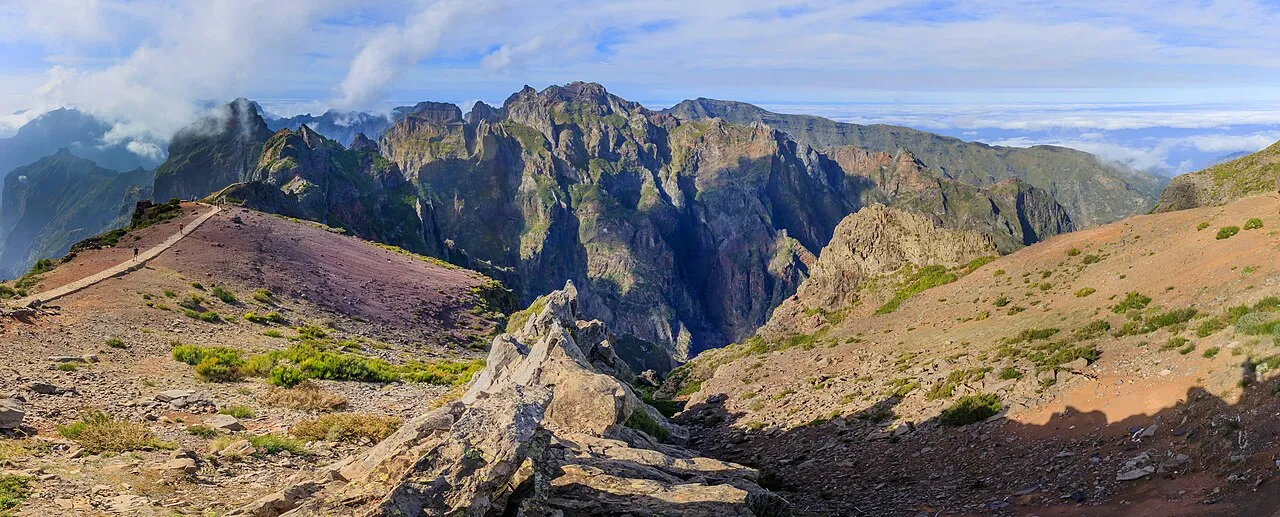
Madeira’s fast road is one of the easiest in Europe to drive. The rest of the island is not hard, it is just steep, narrow and often in cloud. A handful of habits (low gears downhill, patience on single-track lanes, ignoring the sat nav’s shortcuts) are what separate a relaxed week from a stressful one.
In short
- On the fast road, slip roads are short and exits often come straight out of a tunnel. Know your exit before you enter.
- Go down in a low gear and let the engine hold the car. Brakes alone overheat on the long descents.
- On a single-track road, whoever is nearer a wider spot backs up. Expect it to be you.
- Stay on numbered roads. The shortest route is often a lane you should not be in.
- Above about 1,000 m, expect cloud, and drive as if the next bend is hidden, because it is.
The basics (speed limits, where to park in Funchal, filling up) are on our Driving in Madeira page. Choosing and collecting the car is covered in Renting a car. This page is about the driving itself.
The fast road: short slip roads and tunnels
The VR1 runs along the south coast from the west to the airport and beyond, and the newer express roads (VE) cut across to the north. They are free and fast, and they are mostly tunnel and viaduct.
Three things surprise people:
- The slip roads are short. You often join from a standstill or a tight curve, with little room to build speed. Look early, use your mirror and pick the gap before you reach the end. Traffic on the road usually moves over if it can.
- Exits come right after tunnels. You leave a tunnel into daylight and the exit is already there. Check the signs before the tunnel and be in the right lane inside it.
- Your sat nav loses track in tunnels. It may tell you to turn a few seconds late or early. Read the road signs, not the screen.
Dipped headlights on in every tunnel (the law requires them in signposted tunnels, day or night), sunglasses off on the way in. Some tunnels are long and the light change is sharp at both ends.
Going downhill without cooking the brakes
This is the single most useful habit on the island. The road from Pico do Arieiro down to Funchal drops more than 1,500 metres. So do the roads off Encumeada and Paul da Serra. Ride the brakes all the way and they overheat, smell hot and stop working as well as they should.
- In a manual: second gear on steep descents, third on gentle ones. The engine will be loud. That is it working.
- In an automatic: use the low gear (L, 2, or the manual mode with the paddles or the lever) so the gearbox holds the car back.
- Brake in short, firm presses, then release. Not a light constant touch.
- If you smell hot brakes, pull into a viewpoint and give the car ten minutes.
Coming down is also when the car behind will feel closest. Let it pass at the next lay-by rather than speeding up.
Hill starts and parking on a slope
Off the main road, you stop on slopes all day: junctions, traffic lights, car park barriers, the queue behind a bus.
- Use the handbrake on steep starts. Hold the car on it, bring the clutch to the biting point, then release. Many hire cars also have hill-start assist, which holds the brake for a second or two. Ask at pick-up which yours has.
- Leave space in front when you stop on a climb. The car ahead may roll back a little.
- Park with the wheels turned into the kerb on a slope, handbrake firmly on, and the car in first gear (or reverse, facing downhill) in a manual, or P in an automatic.
- Reversing out of a steep drive is harder than going in. If you have a choice, reverse in.
If all of this sounds tiring, it is a good reason for an automatic next time.
Narrow roads: who backs up
Many rural roads, and the old coast roads that tours use, are one car wide with passing places. Here is how it works in practice:
- Whoever is nearer a wider spot reverses to it. Visitors usually are, because locals know where the spots are and will simply wait. Do not take it personally.
- On a steep road, the law says the car going downhill gives way. If someone has to reverse, it is whoever is nearer a passing place; at equal distance, cars reverse for lorries and buses, and between two cars the one going uphill backs down unless that is clearly harder.
- Buses and lorries get the road. On the old roads a bus needs both lanes on bends. Stop well before the bend and let it through.
- Fold your mirrors in if it is really tight. A mirror against a wall costs more than a minute of patience.
- Watch the convex mirrors on blind bends and at junctions. They show what is coming before you can see it.
- A short toot of the horn before a completely blind bend on an old road is normal here, and the locals do it.
Give stone walls on the passenger side more room than feels necessary: that side is the one you cannot see. Most rental scrapes on the island happen at low speed against a wall, not in traffic.
Roundabouts, the Portuguese way
Traffic on the roundabout has priority, as in the rest of continental Europe. With two lanes:
- Taking the first exit: use the outer (right) lane.
- Going further round: use the lane that suits your exit, and once you have passed the exit before yours, move across to the outer lane and signal right.
- Missed it? Go round again. Nobody minds.
Cutting across from the inner lane straight to an exit is the classic cause of roundabout bumps, and in Portugal it is a fineable offence. Lorries and buses are allowed to stay in the outer lane all the way round, so expect them there.
Sat nav traps
Sat navs love the shortest route. In Madeira, the shortest route is often a residential lane at 25% with parked cars on both sides, or a farm track that narrows to nothing.
- Choose the route that stays on numbered roads (VR, VE, ER), even if it is a few minutes longer.
- Be suspicious in Funchal’s hills and above Câmara de Lobos. This is where visitors get stuck.
- If the road ahead looks wrong, it is. Stop, turn round where there is space, and go back to the last main road.
- Save the map for offline use the night before. Deep valleys and parts of the plateau have no signal, and a sat nav that loses its route there tends to invent one.
Cloud, fog, rain and stones
Above roughly 1,000 metres, you will often be inside cloud, especially in the afternoon. Paul da Serra, Poiso, Encumeada, Fanal and the road to Pico do Arieiro are the usual places.
- Dipped lights on, fog lights only if you really cannot see. Slow down to the speed at which you could stop within what you can see.
- Watch for animals. Cows graze freely at Fanal and on parts of the plateau, and they stand in the road in fog.
- The first rain after a dry spell leaves the surface slippery with dust and oil. Brake earlier.
- After heavy rain, look out for stones on the road, especially under cut cliffs on the north coast and the old roads. If a road is closed, it is closed for a reason.
- Wind is strongest at the eastern tip, on the plateau and on high viaducts. Hold the wheel firmly and give cyclists extra room.
The webcams on netmadeira.com show you the cloud before you drive into it, and our Staying safe page covers the rest.
Sunrise drives
Driving to Pico do Arieiro in the dark for sunrise is common and fine. It is a paved road with good surface, but it winds up through cloud with nothing to see beyond your lights.
- Leave early enough not to hurry. The car park is full before sunrise in summer.
- Take it gently on the way up. Other people are rushing too.
- From December to March, check for ice and snow. The mountain roads are closed when it settles, as they were in early March 2026.
- Coming down, use the low gears (see above). You will be tired and the descent is long.
Local habits, and which to copy
- Close following. A local car a metre off your bumper on a mountain road is normal, not aggression. They drive this road every day and you do not. The next lay-by is your friend.
- Overtaking on short straights. Locals do it. You do not need to.
- Hazard lights flashed briefly mean thank you, or warn of a queue ahead.
- Stopping at a viewpoint is fine anywhere with a proper lay-by. Stopping on the road for a photo is not.
Rules that catch visitors out
- Alcohol: the limit is 0.5 g/l, and 0.2 g/l for newly qualified drivers on probation and professional drivers. In practice, one glass and no more. See Driving in Madeira.
- Phones: holding and using a phone while driving costs €250 to €1,250. Hands-free is allowed.
- Seat belts for everyone, front and back. Children under 12 who are under 135 cm in an approved child seat, normally in the back.
- Speed cameras exist on the fast road and in towns, and fines reach you through the hire firm.
- Road closures: the Madeira Wine Rally, usually in late July or early August, closes mountain roads on stage days, and some old coast roads are permanently shut because of rockfall. Barriers mean the road is closed to you too.
The road tours in the Tropi Guide app tell you what you are passing as you pass it, so you can keep your eyes on the bends. Try The Wild North Coast or The Far West once you have found your feet.
Questions people ask
Is driving in Madeira difficult?
The fast road is easy: modern, free and mostly tunnels. The difficulty is off it, where roads are steep, narrow and full of hairpins. Most visitors manage fine by driving slowly, using low gears downhill and getting an automatic if hill starts worry them.
What is the hardest road in Madeira?
For most people it is not a famous road but a village street: a very steep, narrow lane with parked cars and a car coming the other way. Sat navs choosing the shortest route send visitors into these. Stay on the numbered roads unless you know where you are going.
How do I stop my brakes overheating in Madeira?
Use the engine. On long descents, such as from Pico do Arieiro or Encumeada, stay in second or third gear in a manual, or a low gear or manual mode in an automatic, and brake in short firm presses rather than all the way down.
Should I drive to Pico do Arieiro in the dark for sunrise?
You can, and many do. The road is paved and good, but it climbs through cloud with bends and occasional animals. Leave early enough not to rush, use dipped lights, and in winter check for ice or snow closures before you go.