A week in Madeira gives you every part of the island once: Funchal on foot, a dawn on the high peaks, the west coast, the wet north, the bare east, two good levadas and a day with nothing planned. This plan is built so that the mountain days can move. Three of the seven are fixed to places that work in most weather, and four are cards you play when the summit webcam says yes.
In short
- Days 1, 2 and 7 are easy days near Funchal. Days 3 to 6 are the big ones, and you choose their order each evening by the forecast on the peaks.
- Book trail licences online before each hike: €4.50 per person per trail in 2026, €10.50 for the full PR 1 ridge.
- Several of the best walks, the full PR 1 ridge among them, end far from where they start. Arrange the ride back before you set off.
- The Rabaçal road from Encumeada has been closed since January 2024. Reach 25 Fontes from Calheta instead.
- Keep one day unplanned. You will need it for the day the cloud wins.
How the week fits together
| Day | Region | Moves with the weather? |
|---|---|---|
| 1 | Funchal waterfront | No |
| 2 | Old Funchal and Monte | No |
| 3 | The high peaks | Yes, needs a clear dawn |
| 4 | The south-west coast | Rarely |
| 5 | Rabaçal and the far west | Yes, prefers a dry morning |
| 6 | The north coast east | Yes |
| 7 | The eastern tip, then slow | No |
On the evening of day 2, and every evening after, look at a live webcam of Pico do Areeiro and the forecast for the north. Clear dawn forecast: tomorrow is day 3. Heavy rain on the north: move day 6 later and do day 4. Nothing is lost by reordering. The table is a menu, not a timetable.
You need a car from day 3 onwards. Days 1 and 2 are on foot, so pick it up on the morning of day 3 and save two days’ hire. Renting a car in Madeira covers the rest.
Day 1: land, and walk the sea front
Planes into Madeira get diverted when the wind is wrong (see the airport and the wind), so do not book anything with a fixed time on arrival day.
Once you are in, walk The Fisherman’s Quarter: two and a half hours from the fish market, east to the yellow fort, down to the pebble beach the fishing boats launched from, and back along the water to the marina. It is flat, it ends near dinner, and it tells you how the city was built before you see the rest of it.
Day 2: old Funchal, then up to Monte
Morning. The Mercado dos Lavradores is at its fullest early in the day. Look, taste, and buy your fruit at a supermarket afterwards, where the same things cost less. Then walk Doors of Funchal: the cathedral, the Jesuit college with cannon towers, and the painted doors of Rua de Santa Maria. Two hours.
Afternoon. Take the cable car from the waterfront up to Monte, about a quarter of an hour in the cabin (last one up at 17:45). The Monte Palace garden is at the top: €18 in 2026, with last entry at 18:15 from April to September and 17:15 from October to March. Come down to Livramento in a wicker sledge, braked by two drivers in white running beside it. It runs Monday to Saturday from 09:00 to 18:00, and also stops on a handful of holidays. If day 2 falls on a Sunday, swap it with day 7.
Day 3: the peaks at dawn
This is the day most people remember, and the one most likely to be spoiled by cloud. Only play it on a morning the webcam is clear.
Leave Funchal in the dark. The car park at Pico do Areeiro is full before sunrise in summer. Take a torch, a warm layer and more water than seems sensible.
Now choose your walk, because the famous one has a catch.
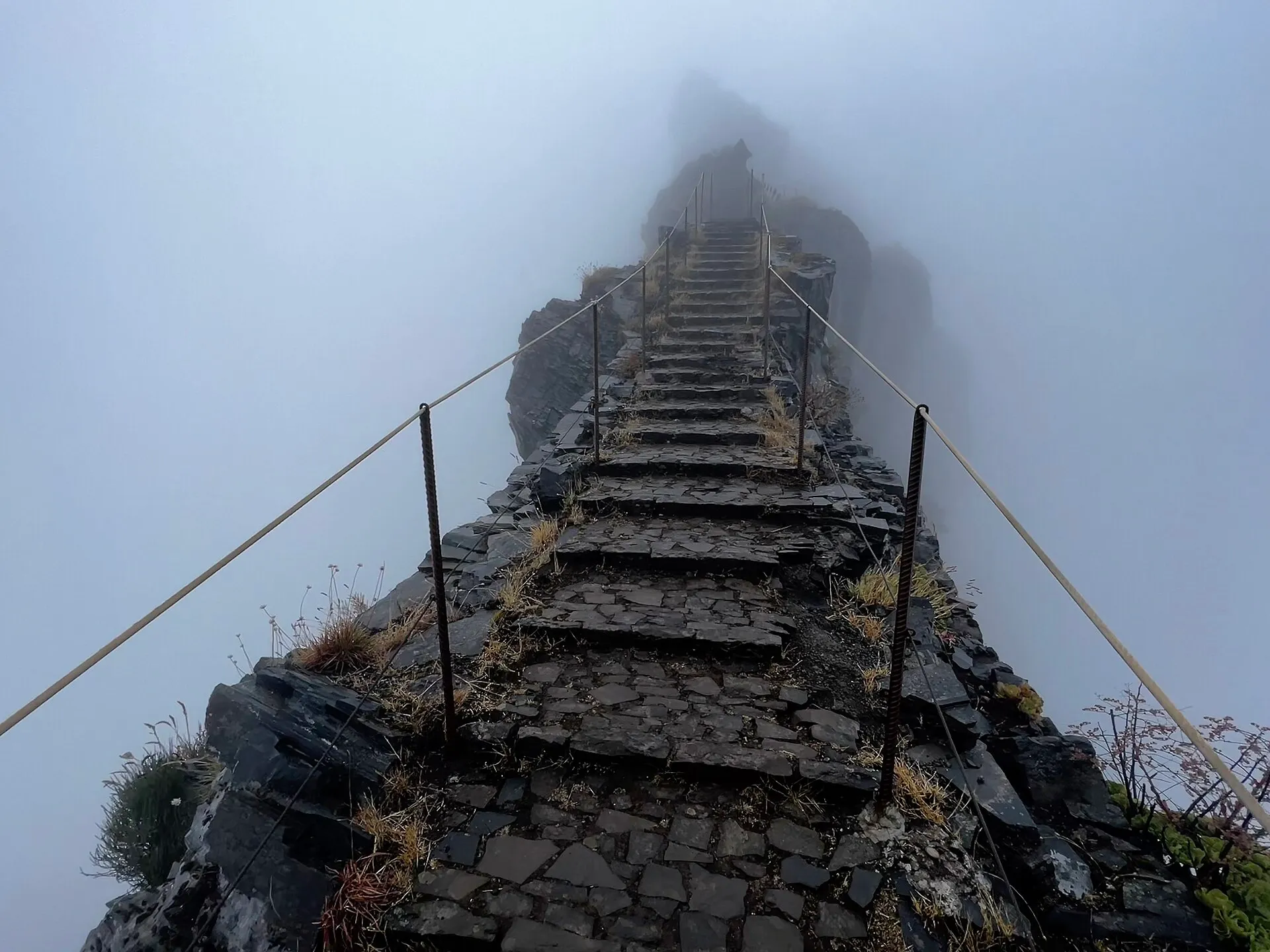
The full ridge. PR 1 from Pico do Areeiro to Pico Ruivo runs 6.1 km through tunnels and down staircases cut in the rock, with long drops beside the path. It is two-way only as far as Pedra Rija. Beyond the gate there it is one way, from Areeiro towards Pico Ruivo (1,862 m), so walking back to your car is not an option. Carry on past Pico Ruivo for about an hour to Achada do Teixeira and take a pre-booked taxi back round to Areeiro, about an hour by road. Allow five hours, not the three on the sign. The licence is €10.50 and comes with a half-hour entry slot; the first slots open at 07:00. Check the IFCN status the evening before, because this section still closes for works and wind.
The easy summit. Drive round to Achada do Teixeira above Santana and walk PR 1.2 up Pico Ruivo: an hour and a half up on a good path, a bit less down, the same summit, and your car waiting. Pair it with the sunrise at Areeiro first if you have the stomach for the early start: Areeiro to Achada do Teixeira is about an hour’s drive down through Ribeiro Frio and Santana.
The short taste. Walk from Areeiro to Pedra Rija and back in about an hour. Your licence stops there and it is checked.
Afternoon: go down, eat, sleep. You will have been up since four.
Day 4: the south-west coast
This is the driest, sunniest side of the island and your safest bet on a morning when the peaks are hidden.
Follow The West Coast from Câmara de Lobos past Cabo Girão (€5 entry for non-residents in 2026, open from 08:00) and the hand-cut terraces to Paul do Mar at the end of the old road. Swim at Praia do Portinho in Jardim do Mar if the sea is calm, or at Calheta, the only golden-sand beach on the south coast (the sand came from Morocco when the marina was built).
Late afternoon, drive back east along the coast to Ponta do Sol, the sunniest village on the island, and watch the sun go down from the sea front. Two headlands keep the northern cloud off it, so it is often clear when Funchal is grey.
If you like to move bases, this is the night to sleep in the west, around Calheta or Ponta do Sol. It saves an hour of driving tomorrow.
Day 5: Rabaçal in the morning, the far west in the afternoon
This is the fullest day of the week, and it works best if you slept in the west. From Funchal, add an hour each way.
Morning. Rabaçal is the start of the island’s best-known levada walks, and the car park on the ER 105 above it fills early. Coming from Funchal, the road from Encumeada has been shut since January 2024, so take the expressway west and climb from Arco da Calheta. From the car park it is 2 km down a paved road you cannot drive. Walk it, or take the council shuttle (€5 one way, €8 return in 2026; carry cash). The council does not publish its hours, so if you want the path before nine, plan on walking down.
Walk the Levada do Risco to its waterfall (half an hour each way) and then the 25 Fontes, about three hours and 8.6 km all told. Before nine you share the path with a few dozen people. By eleven it is a queue. There is one low tunnel and some narrow edges. The forest is damp and cool even in August.
Afternoon. Drive down to the lighthouse at Ponta do Pargo (about 40 minutes from Rabaçal), the westernmost point, and follow The Far West round the corner onto the north coast: a gorge with a waterfall falling into the sea, and a cable car often called the steepest in Europe at Achadas da Cruz, dropping to a vineyard at the foot of the cliff. It ends at Porto Moniz. Swim in the lava pools: the paid complex (€3 in 2026) has changing rooms, a bar and lifeguards, the free pools next door have none of them, and when the swell is up both close because the sea comes over the walls.
Go home over the top if there is still daylight. The ER 209 climbs from the coast to Fanal, where old til trees stand bent in the fog that often rolls back in late in the day, and then crosses the Paul da Serra plateau to the south. It is a narrow, slow road, and not one to drive in thick fog after dark. If you are late, go back along the north coast and through the São Vicente tunnel instead.
Day 6: the north coast, west to east
The north is the wet side. It is greener, steeper and emptier, and it is where you see what the rain built. If it is pouring, do day 7 now and come back.
Take the tunnel from Ribeira Brava to São Vicente, about 20 minutes. From there you have two drives. Both fit in one long day only if you keep the western one short: Seixal is 15 minutes from São Vicente, and the run east from there to Portela and back to Funchal is around two hours at the wheel before you stop.
Go west first on the start of Porto Moniz, Seixal and more, as far as Seixal and the Véu da Noiva, a waterfall that frays into spray down a sheer cliff, seen from the old road. Then turn round and follow The Wild North Coast east from São Vicente, choosing your stops, because the full tour is a day on its own: the saint that arrived in a box, the thatched houses at Santana, the Guindaste viewpoint at Faial, the steam-driven sugar mill at Porto da Cruz, still making rum in the March to May cane harvest, and over the pass at Portela back to the south.
If you would rather walk: replace the western half with the Levada do Caldeirão Verde from Queimadas above Santana. Four unlit tunnels, a waterfall in a green bowl at the end, and about four hours if you turn round there. The car park is small and charged: €2 an hour after a free first half hour, up to €10 a day. Bring a real torch, not a phone.
Day 7: the eastern tip, then nothing
Early. Drive The Eastern Edge to Baía d’Abra and walk PR 8 at Ponta de São Lourenço: two and a half hours on bare red rock with the sea on both sides. Be parked by half past eight. There is no shade, nowhere to fill a bottle until the café near the end (reported to open mid-morning), and wind strong enough to close the trail a few times a year. In October 2026 it is listed as restricted, with short signed diversions you must follow.
Late morning. Swim at Prainha, the black-sand cove below Caniçal, or snorkel in the Garajau marine reserve on the way back, where a small cable car goes down to the shore from 10:00.
The rest. Nothing. Pack, sit by the sea in Funchal, and spend the unplanned hours on whatever you missed. If a boat trip to see dolphins is on your list, this afternoon is the time, or whichever day the mountains were closed to you.
What changes in winter
From November to March the days are shorter and the north is wetter. Sunrise comes later, which makes day 3 easier. Waterfalls like the Risco run full. Trails close more often after storms, so check the IFCN status page on the morning of each walk, not the night before. See weather and what to pack for the rest.
On the long western and northern drives, the app tells you what you are looking at as you pass it, and works without signal in the tunnels and valleys.
Questions people ask
Is a week enough to see Madeira?
A week lets you see every region once, walk two or three proper trails and still have a slow day. It will not cover every levada, but nobody's first week does.
Should I stay in one place for a week in Madeira?
Funchal works as a single base because the south coast expressway reaches both ends of the island. If you like to move, spend the middle two nights on the sunny south-west coast around Calheta or Ponta do Sol to shorten the western days.
Can I walk the full Pico do Areeiro to Pico Ruivo ridge?
Yes, but only one way. PR 1 is two-way as far as Pedra Rija; beyond it you can only walk from Areeiro towards Pico Ruivo, so you finish far from your car. Book a taxi from Achada do Teixeira back to Areeiro, or walk up Pico Ruivo from Achada do Teixeira instead.
How many trail licences will I need for this itinerary?
Between three and six, depending on which walks you choose. Each classified PR trail costs €4.50 per person in 2026, and the full PR 1 ridge costs €10.50. Book them on SIMplifica before the day; each booking has a half-hour entry window.
What do I do if it rains all week?
Rain on the north coast rarely means rain everywhere. The south-west around Ponta do Sol and the eastern tip are the driest parts of the island. Keep Funchal, the boat trip and the Monte day as your wet-weather cards.