The best things to do in Madeira are walking a levada through old laurel forest, standing above the clouds on the high peaks, driving the coast roads, swimming in lava pools and getting out on the water to find dolphins. Which of them you do on any given day depends less on your plan than on where the cloud is sitting that morning, so this list is sorted that way.
In short
- Clear peaks: go high, early. Sunrise at Pico do Areeiro, a ridge or a levada, before the cloud closes in around late morning.
- Cloud on top: stay low. Coast drives, pools, the dry eastern tip, Funchal.
- Every classified PR walk needs a licence bought online first: €4.50 per person in 2026.
- Leave space for the sea. Boat trips, snorkelling and canyoning show a side of the island the roads never do.
When the mountains are clear
Check a live webcam of the summit before you leave. If it is clear, drop everything else.
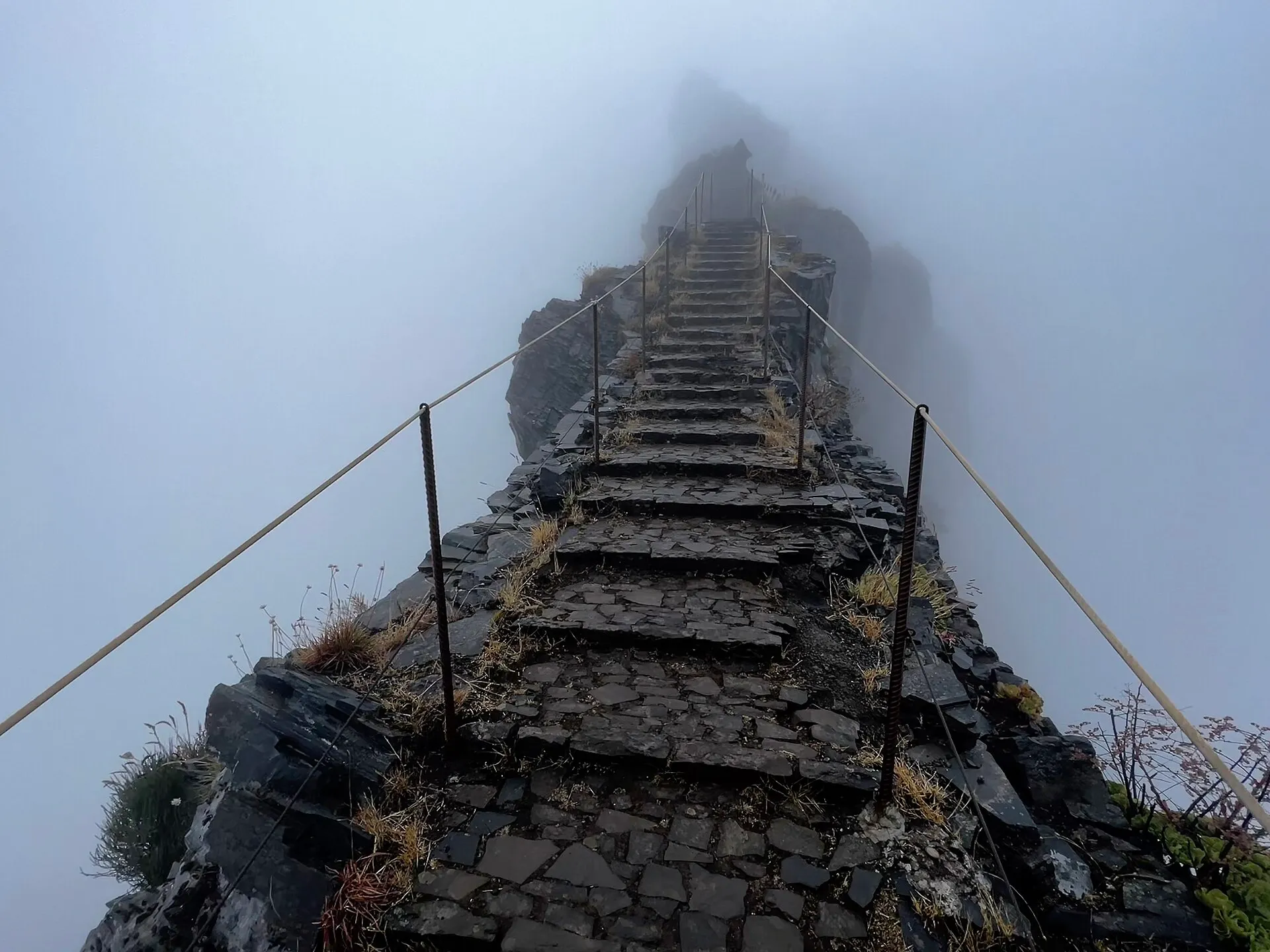
Sunrise at Pico do Areeiro. Drive to 1,818 m in the dark and watch the sun come up over a floor of cloud. The car park fills before dawn in summer. Bring a warm layer: it is cold up there every month of the year. Then walk the first stretch of the ridge to Pedra Rija, about an hour there and back, or commit to the full ridge to Pico Ruivo: five hours, €10.50, one way only beyond Pedra Rija in the Areeiro to Ruivo direction, with a taxi from Achada do Teixeira at the end.
A levada in the laurel forest. The levadas are the channels built to carry water from the wet north to the farms of the south, and the paths beside them are how most people see the interior. Start with Balcões at Ribeiro Frio: flat, about an hour and a half there and back, ending on a platform facing the peaks. If you want a bigger day, 25 Fontes at Rabaçal gives you three hours of forest and a pool fed by dozens of springs. Go before nine, and remember the paved road down to Rabaçal is closed to cars: walk it or take the council shuttle (€5 one way, €8 return in 2026).
Fog forest at Fanal. Not strictly a clear-weather trip, since the old til trees at Fanal look best in mist. But you want dry roads to reach it, high on the north-west plateau.
When the mountains are in cloud
Grey above Funchal usually means grey on the peaks and often means sun somewhere on the coast.
Drive the south-west. It is the sunniest side of the island. The West Coast runs from Câmara de Lobos past the Cabo Girão sea cliff and its glass platform (€5 for non-residents in 2026) to the end of the old road at Paul do Mar. Stop in Ponta do Sol, which is often in sun when Funchal is grey, for a swim and a coffee.
Walk the dry tip. Ponta de São Lourenço is low and bare and often clear when the centre is not. Two and a half hours, no shade, no water until a café near the end that opens mid-morning.
Drive the north coast. In light cloud the north is at its most dramatic: waterfalls running down the cliffs, sea spray on the old roads. The Wild North Coast goes east from São Vicente past the thatched houses of Santana to the pass at Portela. In heavy rain, skip it. Rockfall is real on these roads.
A sheltered walk. The Levada do Rei above São Jorge stays in the trees, holds its shade, and is one of the few popular routes where you can still walk alone. About three and a half hours.
Rum and steam. At Porto da Cruz, the Engenhos do Norte mill, built in 1927, still crushes sugar cane with steam-driven machinery during the March to May harvest and distils rum next to the beach. Outside the harvest the machines stand still but you can walk round them and taste. A good stop when the weather has cancelled your hike.
On and in the water
Dolphins and whales. Boats go out from Funchal marina most days. Dolphins are the usual sighting; whales are the lottery. Choose an operator that keeps its distance and turns its engine down near the animals, and take a pill if you get seasick, because the swell outside the harbour wall is bigger than it looks from the promenade.
Lava pools. The Porto Moniz pools are the famous ones: a paid complex with changing rooms and a free set of pools beside it. The Seixal pools are smaller and mostly local. The south coast has them too, at Ponta do Sol. All close, or should, when the swell is up.
Snorkelling and diving. The Garajau marine reserve, protected since 1986, is the easy one: a small cable car runs down to a pebble beach from 10:00, and the fish start a few metres out: barracuda, moray eels, rays, and turtles on a lucky day. There is a diving centre on the beach if you want to try with a tank.
Canyoning. A wetsuit, a helmet and a rope down the inside of a stream bed, with a guide who has done it a hundred times. Beginner trips are half a day. Some operators take children from 7; others set the limit higher, so check before you book. Book a day or two ahead in summer.
A sunset sail. A catamaran out of Funchal in the evening is the calmest way to end a trip: the cliffs turn gold and there is nothing to do but look.
In Funchal
The old town on foot. The Doors of Funchal walk takes two hours: the volcanic-stone cathedral, the Jesuit college, the painted doors of Rua de Santa Maria. The Fisherman’s Quarter follows the sea from the fish market to the yellow fort.
The market. Mercado dos Lavradores is best early in the day. Look and taste here, buy your fruit at a supermarket.
Monte. Fifteen minutes in a cable car cabin from the old town (€16 one way, €22 return) and you are in Monte, where the Monte Palace garden (€18) fills a hillside with ponds, tiles and exotic plants. The way down is the wicker sledge: ten minutes to Livramento, pushed and braked by two drivers in white, €30 for one person or €40 for two since May 2026. It does not run on Sundays.
A viewpoint for the evening. Pico dos Barcelos, five minutes above the centre, shows you the whole bay. Cristo Rei at Garajau is a Christ with open arms over the sea, older than the one in Rio.
Slow days
Look into Curral das Freiras. About half an hour above Funchal, the Eira do Serrado viewpoint looks straight down into a village at the bottom of a ring of peaks. It is two minutes on foot from the car park, and it works in light cloud as long as the bowl itself is clear.
See the coast from the sea. A catamaran trip west from Funchal shows you Cabo Girão from the bottom, which no road can. A scheduled SeaBus between Calheta, Funchal and Caniçal launched in 2025 (€55 one way), but in October 2026 its operator no longer lists it, so do not plan around it.
Do the west slowly. Spend an afternoon in Jardim do Mar or Paul do Mar, then drive to Ponta do Pargo for the sunset from the westernmost lighthouse on the island.
A rough guide to time and cost
| Activity | Time | Cost (2026) | Book ahead? |
|---|---|---|---|
| Sunrise at Pico do Areeiro | 3 to 4 h with the drive | Free to watch (PR 1 licence if you walk) | Licence only |
| A classified levada walk | 1.5 to 5 h | €4.50 licence | Yes |
| A coast drive | Half or full day | Fuel and parking | No |
| Lava pools | 2 h | Free to €3 | No |
| Dolphin trip | 2 to 3 h | Varies by operator | In summer |
| Canyoning | Half day | Varies by operator | Yes |
| Monte cable car and toboggan | Half day | €16 cable car up, €30 toboggan for one | No |
On a coast drive, the app tells you what you are passing as you pass it, and keeps working without signal.
Questions people ask
What is Madeira best known for?
Walking beside the levadas, the old irrigation channels that cross the island's mountains and laurel forest. After that: the high peaks at sunrise, the lava pools, Madeira wine and the Monte toboggan.
What can I do in Madeira when it rains?
Head for the other coast first, because rain on the north rarely means rain on the south-west. Otherwise: Funchal's old town and market, the Monte cable car and garden, a steam-driven rum mill in Porto da Cruz, or a sheltered levada like the Levada do Rei.
Is Madeira good for non-hikers?
Yes. Most of the famous views are a few steps from a car park, the coast drives are the best way to see the island, and the sea gives you boat trips, snorkelling and pools.
Do I need to book activities in advance?
Trail licences, yes, before every classified PR walk. Boat trips and canyoning are worth booking a day or two ahead in summer. Viewpoints, pools and drives need nothing.
Is Madeira good for children?
Very. Short flat levadas like Balcões, the lava pools at Porto Moniz on a calm day, the cable car and toboggan at Monte, and dolphin trips all work well for families.