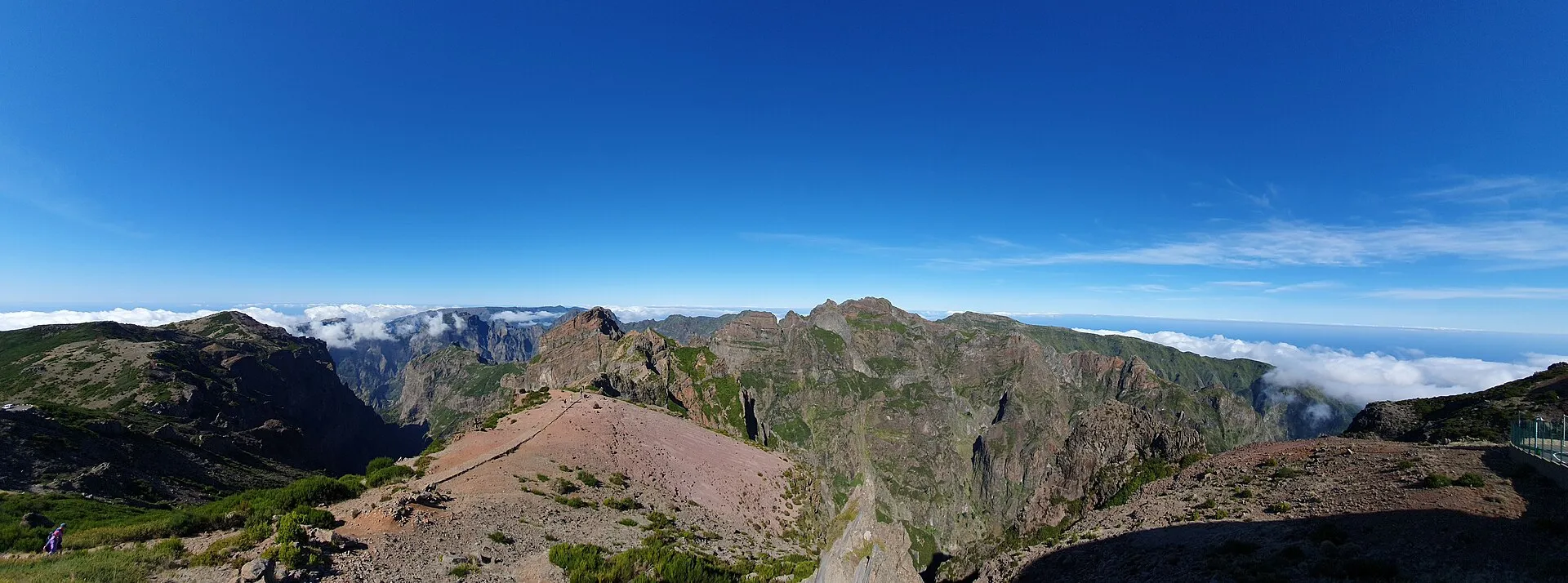
Madeira is 57 km long and it still takes a full day to see one end of it properly. The mountains are in the middle, the roads go round or through them, and the weather on the north coast is often nothing like the weather in Funchal. So the easiest way to plan is by region: pick one area a day, drive it in one direction, and you see more while sitting in the car less.
In short
- Split the island into five days: Funchal, the high middle, the west, the north coast and the eastern tip.
- Go up early. The peaks and the valley viewpoints are clearest before about 10:00.
- Check the north coast weather before driving there. It can rain in Seixal while Funchal bakes.
- Several of the famous stops charge a small fee (Cabo Girão, the Porto Moniz pools, the trail licences). Carry a card and a little cash.
- Hiking trails need a paid licence and some are part closed. Check the status the morning you go.
Funchal and the hills above it
Give the capital at least a full day before you rent a car, or at the end of the trip when you are tired of driving. Most of what matters is within a half-hour walk of the seafront.
The old town and the cathedral
The oldest streets run east from the cathedral to the yellow Fort of São Tiago. Rua de Santa Maria is the spine: narrow, cobbled, and lined with doors that local artists have been painting for more than a decade. By day it is quiet and you can look properly. By evening it is restaurant tables and menus held out at you, which is fun for a night but not the same street.
The cathedral (the Sé) sits at the top of the main avenue, built of dark volcanic stone at the end of the 1400s. Look up when you go in: the carved wooden ceiling is the thing to see, and entry is free. Our Doors of Funchal walking tour takes you through this part of town stop by stop, and The Fisherman’s Quarter covers the waterside east of it, from the fish market to the fort.
Mercado dos Lavradores
The farmers’ market is two floors of fruit, flowers and vegetables around an open courtyard, with the fish hall at the back. Come in the morning, when the black scabbard fish is laid out on the slabs and the flower sellers are still setting up. On Friday it stays open until 20:00. It closes at 14:00 on Saturday and all day Sunday.
The honest warning: the fruit sellers at the front are there for visitors. They will cut you a slice of something exotic, then weigh up a bag at a price you would not pay anywhere else. Ask the price per kilo before anything goes in a bag, or buy your passion fruit from a supermarket and treat the market as something to look at.
Monte, the cable car and the toboggans
The cable car rises from the old town seafront to Monte in about 15 minutes, and the views of the bay open up underneath you all the way. It is not cheap: €16 one way and €22 return for an adult in 2026, half price for ages 7 to 14. Since the April 2026 refit a few cabins have glass floors, at €26 one way or €32 return. It runs from 08:45 to 17:45, and on sunny mornings when a cruise ship is in, the queue is long. Go at opening or after lunch.
At the top, Monte Palace Madeira is a big hillside garden of ponds, koi, tile panels and plants from every continent, with a mineral collection underneath. Allow two hours at least; it is steep, and people who try to do it in forty minutes leave annoyed. Entry was €18 in September 2026.
The wicker toboggans leave from below Monte church. Two drivers in white, straw boaters on their heads, run a basket sledge 2 km down the old road to Livramento, steering with the rubber soles of their boots. It takes about ten minutes and it is exactly as silly as it looks. Since May 2026 a sledge costs €30 for one person, €40 for two and €60 for three, paid on the spot. From the bottom it is a taxi or a steep walk down; there is no cable car at that end.
Pico dos Barcelos and Cristo Rei
Two quick viewpoints close to town. Pico dos Barcelos is ten minutes above the centre and shows you the whole amphitheatre of the city at once, which is worth doing on your first evening so the rest of the island makes sense. Cristo Rei do Garajau, east of Funchal, is a statue of Christ on a headland over the sea, older than the one in Rio. Below it, a small cable car (a few euros return) drops to a pebble beach inside the Garajau Marine Reserve, the best snorkelling on the south coast.
West of Funchal: Câmara de Lobos, Cabo Girão and the sunny side
This is the drive everyone does, and for good reason. It is also the easiest region to combine with a lazy afternoon.
Câmara de Lobos
A fishing town fifteen minutes west of the capital, with painted boats pulled up in a small bay and old men playing cards under the trees. It is named after the monk seals (lobos marinhos) the first settlers found on the rocks. Churchill set up his easel above the harbour in January 1950, and a bronze panel marks the spot. Come late in the day, when the light is low and the bars along the front fill up with locals drinking poncha, which the town claims as its own.
Cabo Girão skywalk
A glass platform on the lip of one of the highest sea cliffs in Europe, roughly 580 m above the water. You stand on the glass and look down through your shoes at the terraced fields on the strip of land at the bottom. Entry is €5 for non-residents and free for children up to 12 (September 2026). The platform itself takes ten minutes. The better photographs are often from the railings beside it, away from the crowd. Late afternoon has the softest light, and the tour buses thin out after 17:00.
Fajã dos Padres
Below the cliffs east of Cabo Girão is a strip of flat land at sea level with fruit trees, a vineyard, a restaurant and a pebble beach, reached by a lift down the rock face from Quinta Grande (or by boat). It is a slow half day: go down, swim, eat, come up. The lift runs from 10:00 to 18:00 for most of the year and to 20:30 from late June to mid-September. The operator does not publish the fare online; a July 2026 guide gives €12 return.
Ponta do Sol and the Anjos waterfall
Further west, Ponta do Sol is a small town in a steep valley that gets more sun than almost anywhere else on the island. There is not much to do here, which is the point: a seafront, a pebble beach, a café, a sunset. Just west of the town, the Cascata dos Anjos pours straight onto the old coast road, and social media has made it famous. The honest note: that stretch of road is often shut for rockfall, Visit Madeira says access is banned for safety, and people have been hurt there. Respect the barriers and see it from a distance, or not at all.
Our West Coast road tour follows this whole coast from Câmara de Lobos to Paul do Mar, with the stories told as you drive.
The high middle: Pico do Areeiro, Pico Ruivo and the valleys
Madeira’s centre is a knot of peaks and deep valleys, and the views from it are the reason many people come. Everything here depends on cloud, and cloud depends on the hour.
Pico do Areeiro
At 1,818 m, Pico do Areeiro is the third-highest summit on the island and the only big one you can drive to. The road ends at a car park, a café and a short path to the top. On a good morning the clouds sit below you like a white floor and the ridges stick out of them. On a bad one you see nothing at all, so look at a webcam before you set off. For sunrise in summer you need to be parked before dawn, and even then the car park may be full.
If you want to walk a little, the first stretch of the ridge path, out to the Pedra Rija viewpoint and back, takes about an hour (PR 1, Areeiro to Pedra Rija). It needs a €4.50 licence, checked on the path. The full ridge to Pico Ruivo (PR 1) is only open one way beyond Pedra Rija at the moment (SIMplifica, 1 October 2026), and it is a serious walk with long drops. Bring a warm layer even in August: it is often much colder than the coast.
Pico Ruivo
The highest point on Madeira, at 1,862 m, has no road to the top. The short way up is from Achada do Teixeira above Santana: about an hour and a half on a good paved path (PR 1.2). From the summit you see both coasts on a clear day.
Eira do Serrado and Curral das Freiras
Half an hour from Funchal, Eira do Serrado is a viewpoint at 1,095 m looking straight down into a village at the bottom of a ring of mountains. That village is Curral das Freiras, where the nuns of Santa Clara hid from pirates in 1566. Park by the shop, walk two minutes up, and it is all below you. Then drive down into the valley for chestnut cake and a glass of chestnut liqueur. Cloud fills the bowl by late morning on many days.
Ribeiro Frio and the Balcões
The easiest way into the laurel forest, the ancient woodland that covers the north slopes and is on the UNESCO list. From the trout farm at Ribeiro Frio, a flat path of about 1.5 km each way runs through the trees to the Balcões, a railed balcony facing the central peaks (PR 11). Small birds, mostly chaffinches, will land on your hand if you hold out crumbs. It needs the standard trail licence. Go early, because the peaks are usually hidden by early afternoon, and the roadside parking is small and shared with the restaurants.
The north coast: Santana to Porto da Cruz
The north is wetter, greener and emptier than the south. Build a loop from Funchal over the mountain and back along the coast, or follow our Wild North Coast road tour from São Vicente east towards Machico.
Santana’s thatched houses
Santana is known for its A-framed houses with thatched roofs down to the ground, painted white with red and blue trim. They were farm dwellings; the ones you see in the centre are a small preserved group, one of them the tourist office. It is a short stop, twenty minutes, not a half day. Photograph them early or late, when the light is less harsh. The real interest is the road there and the drive onwards.
Miradouro do Guindaste and Portela
Between Santana and Porto da Cruz, the Guindaste viewpoint is a platform pushed out from the cliff over the Faial river mouth, with the sea straight ahead. Further east, Portela is the pass where the road crosses from the sunny east to the green north. From its viewpoint you see Porto da Cruz below and the huge rock of Penha d’Águia beside it.
Porto da Cruz
A village by a loud sea, with a free saltwater pool built into the rocks at the beach and a sugar mill next door, built in 1927, that still crushes cane on steam-driven machinery during the March to May harvest and turns it into rum.
The west and north-west: Rabaçal, Fanal, Porto Moniz and Seixal
This is the longest day and the best one. Leave early. Drive up through the middle, down to the north-west corner, and home along the coast.
Rabaçal: 25 Fontes and the Risco waterfall
The most popular levada walks on the island start from the ER 105 car park above Rabaçal. You cannot drive the paved road down: walk it (2 km) or take the council shuttle, €5 one way or €8 return in 2026, cash advised. From the forestry house, the Levada do Risco is half an hour of flat path to a waterfall dropping down a black wall. The 25 Fontes is longer, about three hours there and back, and ends at a pool fed by dozens of thin streams. Both need the licence. Be there before nine or after three: at midday the narrow path becomes a queue in both directions. Coming from Funchal, note that the ER 105 from Encumeada has been closed since 2024, so go via Calheta.
Fanal
The Fanal is a high, open plateau of old til trees, bent and twisted, with cows grazing between them. It is at its strangest in fog, which is most of the time. You do not need to hike: park at the forestry house and wander for half an hour. If you want a proper walk, the Vereda do Fanal crosses the plateau. Bring a coat; it is 1,400 m up.
Porto Moniz natural pools
At the north-west tip, the sea fills a set of basins in black lava rock, and you swim in calm water while waves break on the other side of the wall. There are two options: the managed pools, with changing rooms, a bar and lifeguards (€3 for anyone over three in 2026), and the older free pools a short walk west, with no facilities. More detail on our Porto Moniz pools page. By late morning in summer every coach on the island is here. Go early or late.
Seixal and the Véu da Noiva
Along the coast east of Porto Moniz, Seixal has a black sand beach under green cliffs with waterfalls, and natural pools a couple of minutes away, now with a lifeguard and a €2.50 entry fee. The beach faces north and gets the full swell: on rough days it is for looking at. Just east, the Véu da Noiva viewpoint looks back at a waterfall falling hundreds of metres down the cliff towards the sea. Our North-West road tour covers this stretch.
Achadas da Cruz and Ponta do Pargo
If you have time on the west side, two stops at the far end. At Achadas da Cruz, a farmers’ cable car drops almost vertically down the cliff to a strip of fields and stone huts by the sea (about €3 one way, €5 return). It is steep enough to make many people change their minds at the top. Further south, the lighthouse at Ponta do Pargo stands on a cliff at the western tip, the best sunset spot on the island. Both are on our Far West tour.
The eastern tip: Ponta de São Lourenço
Madeira runs out of green at its eastern end. The peninsula of São Lourenço is bare red, ochre and black rock, with the Atlantic on both sides and not a tree in sight. It is a protected nature reserve, home to plants that grow nowhere else.
Walking the peninsula
The PR 8 path runs from the car park at Baía d’Abra to the far end and back, about two and a half hours. It needs the trail licence. There is no shade at all and the wind is the strongest on the island, so take a hat and more water than you think. Near the end, the Casa do Sardinha has a small café and toilets. The car park is full by mid-morning in season.
Ponta do Rosto
On the way out, stop at the Ponta do Rosto viewpoint. Most people drive past it. From the edge you see the cliffs of the north coast in stripes of colour dropping into deep blue water. It is also one of the best places on the island for sunrise.
Machico and Prainha
On the way back, Machico is where the first settlers landed in 1419, with a calm beach of golden sand. Near Caniçal, Prainha is a small cove of dark sand with no facilities at all. Our Eastern Edge road tour covers the drive from Funchal to the end of the road.
Putting it together
| Day | Region | Key stops | Start by |
|---|---|---|---|
| 1 | Funchal | Old town, market, Monte, toboggan | 09:00 |
| 2 | High middle | Areeiro, Balcões, Eira do Serrado | Before sunrise |
| 3 | West and north-west | Rabaçal, Fanal, Porto Moniz, Seixal | 07:30 |
| 4 | South-west coast | Câmara de Lobos, Cabo Girão, Ponta do Sol | 10:00 |
| 5 | East and north | São Lourenço, Machico, Porto da Cruz, Santana | 08:00 |
Swap days around to follow the weather. If the peaks are clear, go up. If the north is raining, do the south. For driving and rental advice, see our driving guide, and for dodging the busiest hours, beating the crowds.
What people get wrong
- Trying to do the whole island in a day. You will see Porto Moniz from a car park and very little else. One region per day.
- Going up the mountain at midday. By then the cloud has often closed in. The same drive at 07:00 is a different island.
- Not checking the trails. Licences are required and several routes are partly closed. A closed trail is closed; people are turned back.
- Treating the north like the south. It rains more, the sea is rougher, and a beach day planned for Seixal can end in the car.
- Underestimating the roads. Distances are short and drives are long. A 30 km trip on the old roads can take an hour.
If you drive one of these regions with our app, the road tour tells you what you are looking at as you pass it, with the map working offline.
Questions people ask
What should I not miss in Madeira if I only have a few days?
Funchal's old town and market, sunrise or an early morning at Pico do Areeiro, Cabo Girão, the lava pools at Porto Moniz with the north coast drive back, and one levada walk such as the Balcões or 25 Fontes.
Can I see Madeira without a car?
Funchal, Monte, Câmara de Lobos and Garajau are easy by bus or taxi. The north-west and Rabaçal have no useful bus, so you need a car, a taxi or an organised trip. Pico do Areeiro has a bus from the Funchal cable car station twice a day.
How many days do I need to see the main sights?
Five full days covers Funchal, the peaks, the west, the north coast and the eastern tip at a humane pace, one region per day. Add a spare day for weather.
What is the best time of day for the mountain viewpoints?
Early. Pico do Areeiro, Eira do Serrado and the Balcões are usually clear first thing and often in cloud by late morning.
Is Madeira worth it for beaches?
Not for sand. Madeira's coast is rock and pebble, with lava pools and a couple of beaches of imported sand. If sand matters, add Porto Santo.