Stay in Funchal if you will not have a car or if this is a short first trip. Stay in the west (Ponta do Sol or Calheta) for sun and sunsets, in the north for walking and quiet, and near the airport in Machico or Santa Cruz for a short break or an awkward flight. With a week or more, two bases usually beat one.
In short
- No car: Funchal, full stop. Buses outside the city are too rare to plan around.
- The south gets the sun. The north gets the cloud, the green and the trailheads.
- Which part of Funchal matters as much as choosing Funchal.
- Five nights or fewer: one base. Seven or more: consider two.
- Before you book, look at how steep the street is and whether parking is included.
The short answer, by the kind of trip
| Your trip | Where to sleep | Why |
|---|---|---|
| First visit, no car | Funchal, near the market or the marina | Everything on foot, tours leave from here |
| First visit, with a car | Funchal or Caniço, then maybe the west | Central, and you can reach both coasts in a morning |
| Mostly walking | Two or three nights in the north | Trailheads are closer and you start before the crowds |
| Sun, swimming, children | Calheta or Ponta do Sol | Brightest weather, calmest water |
| Winter sun for a month | Funchal centre, a flat | Shops, pharmacies, cafés, and no need for a car |
| Three nights or a late flight | Machico or Santa Cruz | Minutes from the terminal |
The rest of this page explains the trade-offs, starting with the one that decides most of them.
Car or no car?
Without a car, Funchal is the only base that works. Taxis are easy, the city is walkable if you accept the hills, and boat trips, coach tours and airport transfers all start there. The country buses exist, but they are slow and infrequent, and on Sundays and holidays there are fewer still. Our page on getting here and around has the detail.
With a car, the choice turns on something else: what you want outside your door in the morning and at night. The fast road and the tunnels mean that, from almost anywhere on the south coast, the far side of the island is about an hour away.
Funchal: choosing the right street
Funchal is a steep bowl of a city around a bay, and where you sleep in it changes the holiday more than people expect.
Around the market and Rua de Santa Maria
This is the old eastern end of the city: the Mercado dos Lavradores, the cable car up to Monte, and the lanes of painted doors running down towards the fort and the sea. You can walk to the cathedral and the marina in ten minutes and back without a taxi. Our Doors of Funchal and The Fisherman’s Quarter walks both start within a few minutes of here.
The catch is that Rua de Santa Maria is one long line of restaurant tables, and dinner there goes on late. Light sleepers should ask for a room at the back, or look two or three streets up the hill, where it is quieter and a little cheaper.
Between the cathedral and the marina
The working middle of the city. Offices, the main shopping streets, the gardens, pharmacies and supermarkets, and cafés full of people on their way to work. It has fewer views and more apartments, and prices are usually below the old town for the same size. For a stay of two weeks or more, or for remote work, this is where daily life is easiest.
The Lido and Estrada Monumental
West of the centre, the big hotels line the cliff along Estrada Monumental, most with pools and sea-view rooms, and a seafront promenade runs west to the pebble beach at Praia Formosa. It suits families and anyone who wants space and a pool more than cobbles. Be realistic about distance: the old town is a long walk away, and most evenings you will take a bus or a taxi to dinner.
The slopes above the city
Quintas (old manor houses, now hotels) and villas sit on the hillsides at Monte, São Gonçalo and above the Lido. You get gardens, a view over the bay and cooler air, which often means cloud in summer. Every trip down and back up is a drive or a taxi, and the roads are steep.
Twenty minutes out: Câmara de Lobos and Caniço
Câmara de Lobos, just west of Funchal, is a working fishing town with boats pulled up on the slipway, good fish restaurants and bars that serve poncha to locals, not just to visitors. It is close enough to Funchal to eat there most nights and a little cheaper to stay in.
Caniço and Garajau, to the east, are mostly apartment blocks and villas on a slope above the sea, halfway between the city and the airport. It is calm, parking is easier than in Funchal and often free, and plenty of long-stay winter visitors choose it for exactly that. Do not expect a pretty village square. Expect instead the snorkelling in the Garajau Marine Reserve, swimming at Reis Magos, and the view back over Funchal from the Christ the King statue. A car makes it work; without one you will spend a lot on taxis.
The west: Ponta do Sol, Calheta and the cliff villages
The south-west is the brightest stretch of the island. The coast faces the afternoon sun, the cloud that sits over Funchal often stops short of it, and on a clear evening you watch the sun go down over open water from your balcony.
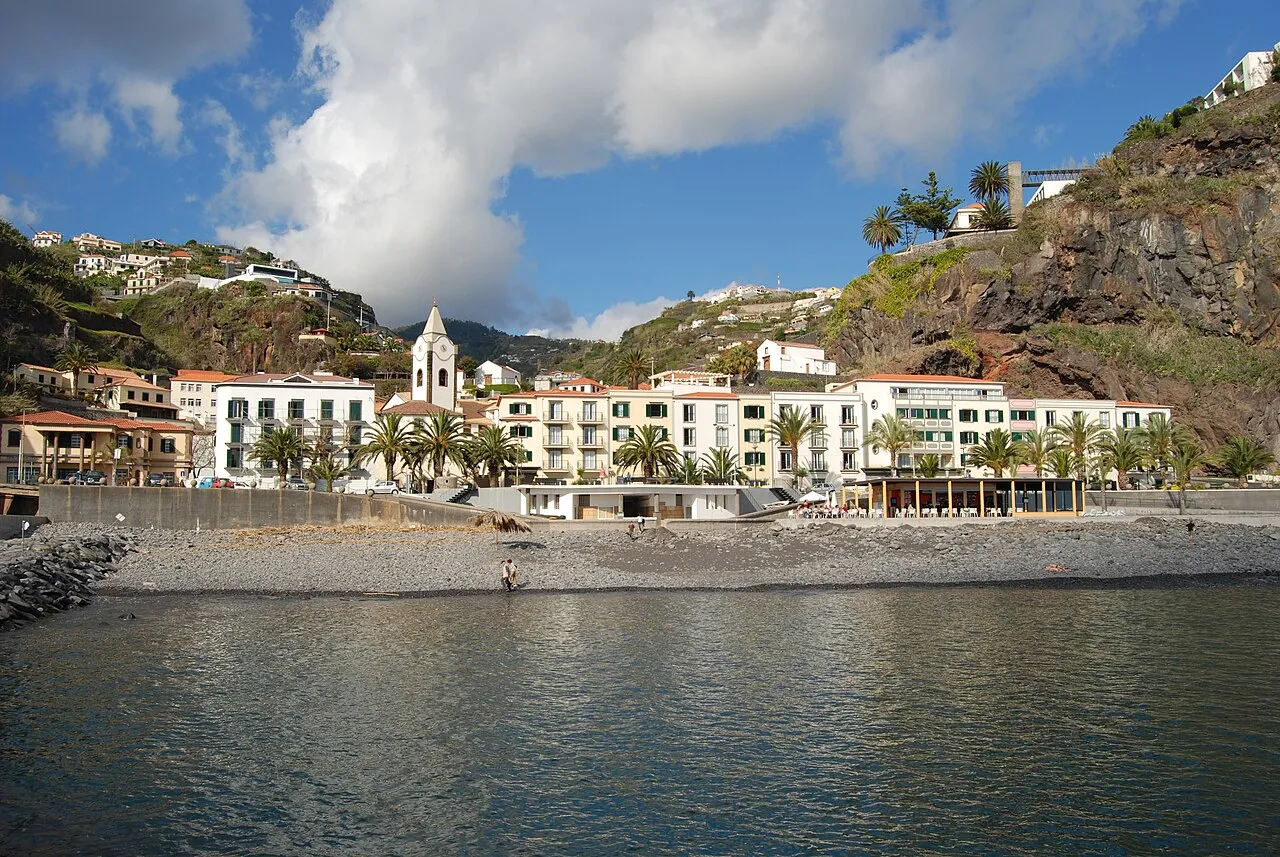
- Ponta do Sol is small, with a seafront and a pebble beach, sheltered by headlands and known as the sunniest village on the island. It has become a base for remote workers. See the Ponta do Sol seafront.
- Calheta has the marina, resort hotels and a calm swimming beach made with imported golden sand. The easiest choice here for families.
- Ribeira Brava is the junction town: the fast road runs past it and the road north over Encumeada starts here, so it saves time on days when you cross the island.
- Jardim do Mar and Paul do Mar are tiny villages at the foot of the cliffs, with surf, a boulder beach at Praia do Portinho and very little else. Lovely if quiet is the point.
From here, Porto Moniz, Fanal, Paul da Serra, the Rabaçal walks and the lighthouse at Ponta do Pargo are much nearer than from Funchal. The price is distance from the city: Funchal’s restaurants become an outing, not a stroll.
The north: for walkers and people who like weather
The north side of the island catches the cloud and the rain the south is spared. In return you get the waterfalls, the laurel forest and the greenest valleys, and far fewer people in the evening.
- São Vicente sits in the middle of the north coast, with a fast tunnel road back to the south. The most practical base on this side.
- Santana, known for its thatched A-frame houses, is the closest village to the Queimadas and Caldeirão Verde walks.
- Porto da Cruz, under the rock of Penha de Águia, has a sea pool and a rum distillery.
- Porto Moniz has the lava rock pools. It is busy with day visitors at lunchtime and very quiet by evening.
- Seixal is a handful of houses and vineyards above a black sand beach.
Restaurants close early and there is little to do at night. If walking is the main reason you are coming, two or three nights here save a lot of early driving. Most classified trails need a licence booked online in advance, wherever you sleep.
Near the airport: Machico, Santa Cruz and Caniçal
- Machico, the island’s second town, has a sandy bay that stays calm on most days, which makes it an easy swim with small children.
- Santa Cruz is right beside the airport, with a seafront promenade. Aircraft come in low over the town.
- Caniçal, an old whaling and fishing village, is the nearest place to the start of the Ponta de São Lourenço walk.
Evenings are quiet and there is not much to walk to after dinner. For a three-night break, a late arrival or a 7 am flight home, it is the sensible choice.
The bases side by side
| Base | Sun | To Funchal by car (approx.) | Evenings | Car needed? | Best for |
|---|---|---|---|---|---|
| Funchal, old town | Good | You are there | Lively, loud at weekends | No | First visit, no car |
| Funchal, centre | Good | You are there | Local | No | Long stays, budget |
| Funchal, Lido | Good | 5 to 10 min | Hotel bars | No | Pools, families |
| Câmara de Lobos | Good | 10 to 15 min | Local, lively | Helpful | Food, poncha |
| Caniço | Good | 15 min | Quiet | Yes | Quiet central base |
| Ponta do Sol | Best | About 30 min | Quiet | Yes | Sun, remote work |
| Calheta | Very good | 40 to 45 min | Quiet | Yes | Beach, families |
| Santana, São Vicente | Mixed | 40 to 50 min | Very quiet | Yes | Walkers |
| Porto Moniz | Mixed | About 1 hour | Very quiet | Yes | The north-west |
| Machico, Santa Cruz | Good | 20 to 25 min | Quiet | Helpful | Short trips, flights |
Splitting the week
For five nights or fewer, stay put. Packing up and checking in again costs you half a day, and with a car you can reach every corner of the island from one bed.
From about seven nights, two bases start to pay. The most common split is Funchal or Caniço first, while you find your feet, eat well and see the city, then the west or the north for a slower second half. If walking is the plan, put the north second: by then you will know how the cloud behaves and which mornings to use.
Before booking two short stays, check whether the property sets a minimum stay for your dates.
Before you book: the details that catch people out
- Look at the street, not the pin. Funchal climbs steeply from the sea. An apartment “ten minutes from the centre” can be ten minutes down and thirty back up. Check the address on a map with the terrain showing.
- Ask about parking. In Funchal, is it included, is it paid, and is a space guaranteed? Outside the city it is usually easy.
- Count the steps. Old town houses and village rentals often mean stairs, sometimes a lot of them.
- Tourist tax. Funchal charges €2 per person per night for up to seven nights, with children aged 12 and under exempt (2026). Other councils have their own rules, so check your booking.
- Porto Santo is a separate trip: a ferry of about 2h15 in normal service (about 3h15 in autumn 2026, for technical reasons), or a 25-minute flight. If you want a beach island, give it nights of its own.
Wherever you end up, the Tropi Guide app has the road tours and walks that start from each coast, and it works offline once downloaded.
Questions people ask
Where should I stay in Madeira without a car?
Funchal, ideally within walking distance of the market or the marina. The cathedral, the cable car, most restaurants and the departure points for boat trips and coach tours are all on foot from there. Outside the city, buses are too infrequent to build a holiday around.
Is it better to stay in Funchal or Calheta?
Funchal for a first or short trip, for choice of restaurants, and for anyone without a car. Calheta for sun, a calm sandy beach, sunsets over the sea, and a shorter drive to Porto Moniz, Fanal and Paul da Serra. With a week or more, many people do both.
Should I stay on the north or south coast of Madeira?
The south coast is sunnier and drier and has almost all the hotels and restaurants. The north is greener, cloudier and quieter, and closer to many of the best walks. Most visitors are happier in the south with day trips north, unless walking is the main point of the trip.
How many bases do I need in Madeira?
One for five nights or fewer: with a car, almost nothing on the island is more than about an hour and a half away. With a week or more, two bases work well, usually Funchal first and then the west or the north.
Where should I stay for the first or last night near the airport?
Santa Cruz and Machico are both a few minutes from the airport. They make sense for a late arrival or an early flight home, and Machico has a calm sandy bay.